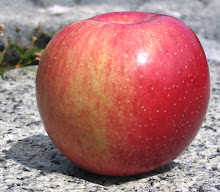
Full disclosure: Honeycrisp makes my teeth hurt.

|
Lots of people like the sweet juicy guys, though, and you might too.
It's a handsome fruit, running medium-to-large, with a streaky red blush over yellow (to yellow-green).
There's a little ribbing and some russet in the stem well, and spots that look light tan against the blush and a darker green where there is none.
The surface is a little uneven, with minor pocks and swells, but the effect is not unattractive.
Let's eat.
The flesh is firm, a crisp coarse yellow that holds a lot of juice. The flavor is super sweet with very little balancing tartness and negligible acidity; there are accents of pear and melon.
Honeycrisp's flavor is simple, direct, and consistent from the beginning of the first bite to the end of the last.
These apples are popular. Minnesota has already made Honeycrisp the official state fruit. Like Macoun, it commands a premium at the market.
I doubt that there are many devotees of both, though. If you think apples should taste like candy, you won't care much for those that suggest wine--and vice versa.
The sign at farmers market for these summarized their appeal as "Explosively Sweet." If apples mean candy to you, here is your fruit. Some people like explosively sweet tea, too.

The University of Minnesota, which holds the patent on Honeycrisps and introduced them in 1991, has a detailed enumeration of their virtues.
Wikipedia's Honeycrisp entry challenges the theory that Honeycrisp is a scion of Macoun and shines some inadvertent light on where new apple varieties come from.
Update: If you like Honeycrisp, you may also like these.
Early Saturday evening prime time nationwide TV here in Kiwiland we have a weekly farming/rural show. Last night was on an apple orchard so I took note. It was on the establishment of the first orchard here in NZ of the previously unknown (to us) variety called Honeycrisp, to be grown for off-season export to the US.
ReplyDeleteThe inventor/discoveror/owner of Honeycrisp from U of Minn was here for the launch, etc. The whole crop will be exported so Honeycrisp will remain unavailable in NZ.
Some snippets from the show that I wrote down. The orchard has 16,000 trees, and each one is pruned to have 37 fruit bearing limbs. Their previous specialty was supply of Gala to the UK supermarket chain Sainsburys. Interestingly the UK market requires small apples, unlike the US/Asia which requires large apples.
They use a low spray and biological pest targeting regime which means they had to completely upgrade their post-harvest apple washing system to get all the extra good and bad bugs off the apples. The automated apple grader/packer sorts the apples by size and mixes and matches them so that each carton of apples is full to the top but only contains the required 18 kilograms of apples.
Wel anyway, you probably know much of this but it was interesting to see how a large orchard worked.
This is all about Honeycrisp taking over the world.
ReplyDeleteNova Scotia is subsidizing Honeycrisp trees, and there is a bill in the U.S. Congress that would do the same here.
A subsidy war is brewing; soon growers won't be able to afford not to plant Honeycrisp.
With New Zealand preparing to meet our Honeycrisp needs in the spring and summer, we are on track for all-Honeycrisp, all the time.
It would be poetic justice if by the time these trees started to bear the public had moved on to something else.
Have you tried SweeTango? It's a HoneyCrisp x Zestar cross. Many people it's better still. See: http://sweetango.com for more information.
ReplyDeleteWhat do you think about "managed varieties" of apples in general?
James, I seek out every variety that comes my way. This one hasn't made it to my part of the world yet, but I am sure it will.
ReplyDeleteHave you tried it? What is it like?
I am fine with "managed varieties," assuming you mean apples that (like Sweetango or Honeycrisp) are promoted by marketing campaigns funded by licensing fees, or by an exclusive licensee. Some of these apples are very good.
But I can't help but notice that most of these new managed varieties have awfully similar flavors. I think that is a product of a winner-take-all marketplace which rewards the "best" variety and says the others aren't any good at all.
I prefer a "de gustibus" marketplace with lots of choices and variety, and with low barriers to entry, where a fine old variety like Baldwin or a newer one like Topaz is sold even though their patents have expired (which means there are no licensing fees to pay for advertising).
It will be interesting to see what happens to Honeycrisp now that its patent has expired. Will the public stay the course or be seduced by the next marketing campaign?
Много добри ябълки
ReplyDelete"Много добри ябълки" = "Many good apples" in Bulgaria.
ReplyDeleteThank you for visiting!
I am certainly no expert in apples, my favorite fruit being the cranberry:) But, Honeycrisp will keep me coming to it long after the patent runs out. I just tried a Pacific Rose...it was expensive $ per pd, and I wondered why? I was unfamiliar with the name and thought to give it a go. It was very good!!...but Honeycrisp you have my heart:) And thanks Kiwi for your informative post...very interesting. I now know why I am seeing a 'spattering' of Honeycrisp in some stores as we speak...they are few and far between, but can be found. But truly, the Honeycrisp from western WI cannot be beat.
ReplyDelete@naturemich, I think we are seeing Honeycrisp become a year-round apple, much as Granny Smith and Red Delicious are today.
ReplyDeleteI just wanted to chime in as say that I indeed love Macoun and Honeycrisp both for eating out of hand. Macoun clearly has much more going on for complexity of flavor and I like the smaller size. Honeycrisp is like a healthy candy.....sweet and crunchy! These would be good to buy and try together.
ReplyDeleteRe "try together": did that
DeleteSo after hearing a lot of raves and praises for the honeycrisp is it actually worth the hype? I'm a huge fan of Pacific Roses and other apples dull in comparison. So how does the honeycrisp measure up to the Pacific Rose?
ReplyDeleteAngela, both apples have extremely loyal followings--just read the comments above. And they are both modern apples bred for sweetness.
ReplyDeleteStill I do not think of them as being very much alike really. Pacific Rose has much better flavors, in my view.
The best way to satisfy your curiosity is to give Honeycrisp a try. The two varieties are not widely available at the same time of year anyway.
I did not realize how expensive honeycrisps were! I did buy one to try and you are right, the pacific rose is quite different AND I definitely prefer it over the honeycrisp. It's so hard to eat other apples after Pacific Roses now!
ReplyDeleteAngela, because of their popularity, Honeycrisp commands a premium at the market. It is also tricky to grow.
ReplyDeleteIn my part of the world, the only other apple to be similarly priced is Macoun.
Good for you for trying something new. Now you know.
If you like Pacific Rose, I wonder what you would make of such highly flavored English varieties as Cox's Orange Pippin. Not as sweet as Rose, but marvelously complex.
Can not find the answer - This variety is immune to scab?
ReplyDeleteWelcome, Andrey!
DeleteThe various agricultural extentions services seem to agree that Honecrisp resists scab well, but is not immune.
Ontario, for example, notes,
One positive attribute of ‘Honeycrisp™’ is that it is highly resistant to venturia sp. (apple scab) but not completely immune.
See also John Clements writing for UMass.
Adam, thank you so much for your help.
ReplyDelete(Links are very useful)
Adam, I think you describe Honeycrisp really accurately. We do like them at my house. Horrible to think it was nearly discarded as a cultivar!
ReplyDeleteThanks for maintaining such an impressive list of apple varieties here! Up with heirloom, and down with monoculture!
Maddy, thank you! I share your appreciation of the heritage varieties, but like you also value some of the newer apples, such as Honeycrisp.
DeleteThe interesting question for me is, what does it take to get more choices at the market?
Old or new, is there room for breeds with different characteristics? Or will the structure of markets only allow well-financed sugar bombs to succeed?
I love a lot of different apples. Top favorite is still is McIntosh. Though I love Nova Mac, Gala, Cortland, Gravenstein, Honeycrisp, SweeTango, Spartan, Ambrosia and Golden Delicious too name a few.
ReplyDeleteI just got a Honeycrisp trees, for $20 dollars. I was hoping to grow some, since they are so expensive to buy. $3.99 CAN a pound, though in season they go for as cheap as $1.25 CAN a pound.
Was wondering what would be good trees to grow with it? Or what would be good to pollinate it. Was also thinking of trying to cross it with a McIntosh or Cortland because they grow really well here. Specially since they are my top three favorite apples.
I quite like the idea of one's own micro-breeding program. Why should big operations like UMinn have all the fun and glory? And crossing Honeycrisp with a tart apple like McIntosh could be truly great.
DeleteOrange Pippin has a partial list of HCrisp pollinators that includes Cortland and Macoun.
Goog luck, let us know how it goes!
I love this apple, with a nice chunk of apple wood smoked Havarti or Cheddar cheese. It's expensive for sure, and often difficult to find. We get it in December and then by mid-January you'll be hard pressed to find any in the stores.
ReplyDeleteLike Byron, I've gone so far as to get my own tree - a 6-way espalier with each branch a different variety to ensure even the triploid varieties get pollinated. It's in it's 2nd year of producing fruit. It hasn't been great. Too much rain and cold in spring and summer and a very hot and dry, prolonged Indian Summer that lasted through end of October made for a very poor harvest.
I have avoided the Honeycrisp for many years now. From what I recall, they were big, juicy and innocuously sweet with little personality (in that case, very much like the Pacific Rose.) I recently discovered smaller and more 'orchard-y' looking ones (not uniform in shape, thicker skin) at Walmart and decided to give them another shot. The two that I've had so far have been barely sweet at all and very sour/bitter not unlike a grapefruit.
ReplyDeleteI'm wondering if this is due to overbreeding? Sitting too long? Not long enough? I don't know much about how apples age. Once they are in my possession, they don't last long. :)
Hi.
ReplyDeleteA short comment from Russia about Honey Crisp
After frost -39,2 C (-38,56 F) last year growth has suffered, but not very much.
Photos fruits of growth and on my website
http://nizovo-sad.ru/index/khani_krisp/0-116
Interesting. I took a leap of faith and planted two Honeycrisp trees without ever having tried the fruit itself. It got such rave reviews that I hoped for the best. I'm only a year in, so we'll see what happens once they start bearing...
ReplyDeleteKristi, it is interesting to see people trying out this apple small scale now that it is no longer protected by patent. I hope your experiment is a success!
DeleteI grow honey crisp apples they are a very hard apple to grow because they get bitter bit low calcium they make excellent cider the apples in the store is junk go to apple orchards and pick you oun if there is any left
ReplyDeleteCarl, I have heard that about Honeycrisp—tricky to grow.
DeleteHard to find any orchards outside of Minn. where you can pick them, I think! Though now that they are off patent that may change.
Lately I keep running into Honeycrisps that taste, in whole or in part, like raw sweet corn! I am not sure where the apples are coming from (I'm not the family shopper), or if this is some kind of preservation process that keeping them in the market this late (early?).... any thoughts? Has anyone else run into this?
ReplyDeleteHi Heather! I do not eat enough Honeycrisps to say, but storage often attenuates flavors, lets hidden flavors emerge, and (less often) brings forth new flavors.
DeleteWhat do other have to say?
I am a small time commercial (retail) apple grower who brings home supermarket apples regularly, gotta keep up with what the majority of the population experiences. My most common observation/complaint is off flavors associated with bad storage atmosphere. Apples packed and shipped in cardboard pick up the 'essence of cardboard' (they may reside in that cardboard for months), apples stored in stale, mixed refrigeration pick up whatever broccoli/onion/durian/sweetcorn essence that is floating around. Apples picked early for long term storage, immediately placed into controlled atmosphere storage (often not the freshest smelling rooms), shipped to distributors in refrigerated semi trailers, where they may reside for weeks in mixed storage, placed in suspect refrigeration at the store level, before they are placed out at room temperature for everyone to handle don't start out with fully developed flavor and have multiple opportunities to pick up and display unexpected and uncharacteristic flavors.
DeleteI will say that I've observed overall conditions improving a lot over the last generation (at least before the fruit gets to the store) and the cornucopia of fresh fruits and vegetables available in a modern supermarket is something of which kings of 100 years ago could not conceive. But... having tasted the best at its peak of perfection allows awareness of the compromise inherent in our modern food production/distribution system.
Dunno - I don't want to complain with my mouth full....
David D.
Durian, ha.
DeleteWell, that explains why the last bag of honeycrisps I got reeked and tasted of onions...
DeleteHoneycrisps are way too sweet for my tastes. Give me a good ol' Granny Smith any day.
ReplyDeleteWest WI: I don’t care for Honeycrisps much. I prefer winecrisps. I like a good balance of tart and sweet and more complexity. I was recently trying to track down some Crimson Crisps and had one place tell me that they had sold out, but maybe I’d like to try Honeycrisp as it was similar. I politely told them I had had both and didn’t feel they were at all similar. Oh well, no Crimson Crisps this year. . .
ReplyDeleteIs there a difference (taste-wise) between Organic and Non-Organic apples?
ReplyDeleteYou know, that is a really good question, probably deserving a full blog post.
DeleteApples of all kind are handled differently, from harvest to storage to retail point of sale.
Any differences in taste and texture that I have experienced (but not tracked) are minor, and I assume they have to to with handling rather than use of chemicals.
An organic apple is not likely to have an artificial wax applied. These waxes can have a bitter disagreeable taste. They also help to preserve the fruit quality, which I suppose would be a difference that is more pronounced the longer the fruit is off the tree.
So, it's complicated!
From my personal experience...
Delete* Sometimes there's even a taste difference between apples picked from different branches of the same tree... and that's how breeders find new sports :-)
* No, the normal use of pesticide sprays doesn't affect fruit taste;
by normal usage, I mean:
1) recommended dosage that doesn't cause chemical burns;
2) fruit should be harvested only after expiration of the recommended post-treatment waiting period.
I do agree with Adam: the post-harvest handling, treatment & storage routines affect the fruit qualities substantially.
* Some growers pick significantly underripe apples (to prolong storage times), which results in rather bland tastes.
* Even simpler storage terms and conditions (time, temperature, atmosphere) do affect the tastes.
* Needless to say there's a lot of artificial treatments to prolong "freshness" and prevent spoiling: waxes, calcium nitrate, 1-MCP etc.
If you want the best-tasting apples, perhaps you should find a supplier that picks apples at the right time and doesn't use any chemical post-harvest storage prolongation treatment. Small to medium-scale farms & orchards, I suppose.
In any case, when apples grow, some dust falls on them from the air...
If it looks dirty, it's better to wash it carefully (and when it's artificially waxed, probably it's better to get rid of the peel altogether).
BTW, when the apple is rotten, it doesn't matter whether it was "organic" or "non-organic"...
Here's a link to a recent 'strawberry chat' with guest Marvin Pritts of Cornell. If you go to 43:20 of the presentation, Dr Pritts discusses quality differences in strawberries between different cultural programs - organic, conventional, and variations. I know it's not apples, but this scientific study reflects my experience with tree fruit.
ReplyDeleteThe proverbial apples-to-strawberries comparison!
DeleteIn case the embedded link did not work in the previous post: https://creators.spotify.com/pod/show/strawberrychat/episodes/Strawberry-Production-in-the-Northeast--Interview-with-Dr--Marvin-Pritts--Episode-17--May-1-2024-e2j6if1
ReplyDelete