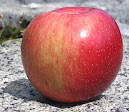
Today's apple may be the oldest variety I ever will taste. These are crab-apple sized and when Lady is bearing her branches are festooned with small fruit so thick as to resemble garlands of apples.

|
| A garland of Ladies contra-dance against the October sky |
A closer look at this ancient variety below the fold.
The tight clustering of Ladies on the bough accounts for the dappled pattern of blush over the cheerful spring green peel: red where the sun shone, green for the shadows of fruit.

|
The blush itself ranges from streaky to a saturated cherry red corresponding again to the quality of sunshine.
Lady varies in shape but seems to be typically oblate with little or no ribbing, though there's more ribbing in some.
Nowadays Lady Apple, harvested late in the season, is a traditional holiday decoration. I've tried some from supermarkets and been unimpressed.
But a reader recommends them, and I had a chance to buy a few direct from their farmer, who also said she'd been drawn to snack on Lady this fall.
 There must be some reasons we've kept Lady with us since Roman times. Shall we
find out what it is?
There must be some reasons we've kept Lady with us since Roman times. Shall we
find out what it is?
Lady's flesh is a beautiful fine-grained snowy white with some green highlights, each bite crunching off nice and loud. She oxidizes quickly.
Her flavor is light and delicate, balanced with sweet notes and no acidity. The dominant taste is sweet but there is a savory, nutty quality as well, though this is watered down. These tastes conclude with a lovely minty note. A bit like spearmint.
I find I do like Lady very much. The juxtaposition of these flavors versus their tentative expression is curious and light and wonderful. It takes about three bites to dispatch one, plus nibbles.
Okay, about that Roman thing. Many sources are willing to say that Lady may be "the Appian Apple of the Roman Empire." My skepticism is naturally aroused when I find a single phrase like that repeated verbatim with no further information or attribution. Where is the scholarship?
The assertion that the apple dates from the Forest of Apis in Brittany in the early 17th century seems to be on firmer ground (some say earlier). In the United Kingdom, where Lady is better known as Api, the National Fruit Collection supports this story.
I have raised Lady (Api) and find that flavor and color is enhanced by a frost. They keep well in a bucket in the garage. They will keep well without refrigeration into February or later. We use them for Christmas decorations, then eat them.
ReplyDeleteI still have a few of these and they have held up very well.
ReplyDeleteThere is a Lady apple tree around the corner from me. I first noticed some bright red orbs from the road, and thought they were a late plum. When I stopped to look, I was stunned to see so many beautiful fruits, and tasted one, which wasn't bad at all, for a crab apple! The house is for sale, and I hope that I can pick some, as I plan to make jelly from these apples. I have three mature apple trees on my property which I'm trying to identify, and have planted five more. This year brought our temperate climate an amazing amount of fruit! Sadly, most will go to waste. Thanks for this great blog, Adam.
ReplyDelete@Seapunk: Thanks for reading! I should think the Ladies might be a little early at this point, but maybe not.
DeleteWe've had our rainy season start, and lots of wind, and still, the Ladies are holding tight. I'll go over and pick when the quince seem ready. :)
DeleteHello Adam. Thank you for a excellent blog and great work with introducing us to apples. In my place (middle Europe) "everyone is sure" that this is our's old heirloom apple and that it originates from here. We named it by several synonyms connected mostly with Christmas or with cakes. I have one such plant in garden and really, it is good mostly for cakes ;) Our variety is much more red than green probably because of warm summers but same tart and splashed, white fleshed with some green points inside. I pick it for storage at end of October.
ReplyDeleteThis may be the oldest cultivated variety and the bearer of many stories. What are some of your names for it?
DeleteTypical and most used names in our region is "Božićnica" where "Božić"=Christmass or "Kolačara" where "kolač"=cake. Here you can find some old european apples in German and France languages: http://www.fructus.ch/sorten/aepfel/
DeleteYou can also see some old heirloom variants in our area but I suppose you will not understand a word http://www.stare-hrvatske-vocke.com/katalog-starih-sorti-jabuka.html Anyway, you can see the pictures :)
@John Smith, that is marvelous, thank you! So many apples.
DeleteI think I recognize a few of those, but who can say?
Thank you, John!
Hi, can anyone recommend an online vendor that sell these lady apples? I live in FL and can't find a grocery store that sells them. They are the perfect size and flavor for caramel apples.
ReplyDeleteI'm fortunate enough to get these from a local orchard, but of course that is not an option everywhere in the world!
DeleteI am also used to seeing these in supermarkets around Thanksgiving and Christmas, so there must be a wholesale market for these too.
Good luck finding a supply!
I got Lady again this year near Wenatchee, WA. This was their best year yet. After keeping in the refrigerator for two months they were still hard and juicy. The almond taste (!) was pronounced. What this could do to a cider blend!
ReplyDelete