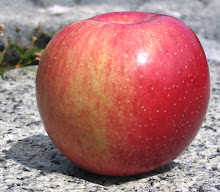
A famous, fabled apple that many feel is simply the best. And, yes, it is fabulous.

|
Cox's Orange Pippin runs medium to medium-large and is round, oblate, and ribbed. The blush is indeed an orange-red, sometimes uneven, over yellow green and with considerable russetting.
Brown lenticels freckle the whole surface, which is matte, not glossy. Cox's sits firm in the hand and smells slightly mossy or grassy.
The flesh is creamy light yellow and more fine-grained than that of its reputed parent, the Ribston Pippin. It's got a tender, but substantial, crunch and carries a moderate bit of flavorful juice. And, those flavors!
This is a wonderfully well-balanced apple with a complex bouquet of tastes: cider, a hint of cinnamon and hazelnut, and strong orange and mango notes.
The even sweet-tart balance is the perfect backdrop against which these flavors gracefully unfold.

Compared to the powerful and unruly Ribston, Cox's is more refined and disciplined but no less flavorful. The general effect is marvelously complex, rich, and satisfying on more than one level.
Small wonder that to many connoisseurs Cox's is the best desert apple. Yorkshire-based Orange Pippin, its very name a tribute to this variety, praises Cox's and concludes
Flavour is a very personal thing but Cox's Orange Pippin is "essential reading" for anyone interested in apples. In terms of flavour it is unquestionably the benchmark against which all others are measured, as well as being (along with Golden Delicious) one of the most influential apple varieties for apple breeders.
Orange Pippin makes other notes and comments about Cox's, and lists 24 daughter varieties, an indication that the fruit's qualities are prized by breeders as well. (Vintage Virgina lists a few more offspring too.)
Across the years, Robert Hogg (The Fruit Manual, London 1884) tells us that Cox's originated in 1830 in Colnbrook, near Slough in England; today this is just west of Heathrow Airport.
Cox's remains popular in the United Kingdom despite difficulties in cultivation; in America this variety is not widely available (but worth the hunt).
My samples this year grew in New Hampshire, but Shelburne Farm in Stow is one Eastern Massachusetts orchard that has them for picking (in season).
The seeds of a ripe Cox's Orange are said to rattle in their cavities when the apple is shaken, but I could not create this effect.
Update: The rattle is here.
Great research info. I enjoyed reading about cox himself in that link. We Might need to go to England to try his cox pomona,if not its already unreachable but we can always try.
ReplyDeleteGot 35 of these cox orange going in the ground, can't wait to finally grow it.
Thirty-five Cox trees! That's really great. And a lot of apples, if you have a good crop--which I hope you do.
ReplyDeleteDo you have any special plans to sell these, to chefs or connoisseurs? Is there a chance any of these will make their way as far south as Boston?
Yes, I will eventually accept orders from from SMALL retailers,chefs, connisours, or anyone who loves organic apples. We will eventually have a small store that is suitable to accommodate retail customers on our farm.
ReplyDeleteWe love our out of state friends, so.
For those that live outside of Maine, bulk orders and buyers club orders will be able to be placed with crown of Maine organic cooperative beginning in 2012 season, who deliver local Maine produce to the Boston area every week. Will keep you updated when I finish making my blog, and I will as things progress in the coming seasons!
We will also be selling exceedingly rare varieties exclusively at the common ground fair, in unity Maine, in the end of September which falls on the 23,24,25th this year. Unfortunately our harvests won't sustain the huge demand yet, so we won't be attending until next year when apples will be booming!
Adam, you wouldn't believe it but I inadvertently stumbled unto an actual picture of Cox Pomona without even trying. Take a look. That Flickr has a lot of good pics. Just go back and forth its alphabetical
This comment has been removed by a blog administrator.
ReplyDeleteHawk Farm also provided this link to a photo of Cox Pomona.
ReplyDeleteCox P is another daughter of the Ribston Pippin. Thanks for the photo!
Adam,
ReplyDeleteWhich of your orchards had a good supply of cox? I am going to check in with people in my area, but the hail a few weeks back severely reduced the Apple crop in Maine and new Hampshire. I'm going to call hutchins farm too and see how their crop has faired.My trees won't produce till next year, and of my two ancient trees, only the cider tree has a good crop because it is overbearing. The other is a cox/ribstone seedling planted in my town in the late 1800s. It's called Starkey, ill email you the write up.
Hawk, I don't know that anyone here has a good supply of Cox's, but Shelburne Farm (in Stow) has two trees.
ReplyDeleteI hope these will be open to picking will be this fall; they were not last year.
Starkey sounds great, is it hard to grow?
No, it is a manageable tree even on standard, and a reliable producer. It is a seedling of ribstone, so it is essentially a native Maine version of cox. Here. Is a list of some of the native Maine varieties http://www.fedcoseeds.com/trees/apples/byphoto.htm
ReplyDeleteStarkey is at the bottom. It is strikingly similar to cox, a bit more rosey of a red. It has the complexity of cox, and is my favorite. I planted a substantial amount.
Im going to have to go hunting around Maine and mass to get a good supply of varieties for the winter. I'll send you and email so we don't flood your reports with talk.
ReplyDeleteHi Adam,
ReplyDeleteA local heirloom apple grower here in Southern Wisconsin brought a load of Cox's to our farmer's market this weekend. I bought a few and my wife and I tried one this weekend. The bite and chewy texture was great! The flavor was intense and I was not able to discern any one flavor. Maybe letting them sit in cold storage for a month or two would help them mellow out (reduce the acidity).
We also had a Pink Pearl. The skin was milky light and the flesh bright pink. This apple had a great sugar/acid balance. I liked Pink Pearl better than the Cox. I suppose growing a maritime-loving apple in Wisconsin could change the flavor of the Cox; or it could be that there is so much going on I could not discern any flavors. I had the same results from eating an unkown russet earlier this year. It was so intense in flavor/acid that nothing came through. I think maybe Cox's might be better eaten in Winter for me as I like less acidity.
So I am now eating the Cox's after about 5 weeks or so off the tree. What a difference. The flesh is not quite mealy but more the English "chewy" texture. The sharpness is gone and is replaced with a sweeter tropical taste - I personally get alot of bannana flavor. The flesh is somewhat dry but enough juice to keep my tasting happy. Overall a pretty tasty apple. Although I must say the Pinova (cox-duchess-yellow del. cross) gave me the same fruity tropical flavos with a bit more cruch, juice and sweetness. For me, the Cox needs to mellow a month or so off the tree before eating.
ReplyDeleteI ate this apple at Clarkdale during Franklin County Cider Days, and MUST have more. The best apple I have ever eaten.
ReplyDeleteAnd I have to get out to Cider Days one of these autumns. Lucky you!
Delete"Prized by breeders" might be an understatement! Wikipedia lists 75 different descendant cultivars of Cox's Orange Pippin; varieties with great names like High View Pippin, Polly Prosser and Sweetie Darling.
ReplyDeleteDon't you wish you could try some of these? I sure do!
Great link, thanks! So many apples, so little time, and so hard to find.
DeleteAh, I cherished them while I was working in England, some fifty years ago. They are superb. I do wish they grew here, with that same wonderful flavor.
ReplyDeleteThey do grow here.
DeleteWhile I'm in no position to compare with apples from the Jolly Old Place, American Cox's can be very very good.
Hello,
ReplyDeleteI am in search of the elusive apple, Cox's Orange Pippin. I see that one of the comment's above mentions an heirloom grower in southern Wisconsin--not far from me in the northwest suburbs of Chicago. Do you have any idea what orchard this fellow (Matt) might have been referring to? I'd really like to get some of these apples!
Sincerely,
Naomi Mellendorf
Palatine, Illinois
(northwest surburbs of Chicago)
Naomi, it does not seem as though Matt is with us at the moment (more's the pity) and I am not from the midwest.
DeleteBut you might try the search engine at Orange Pippin that lets you search orchards by fruit.
I'm seeing one Cox's grower near Jollet and one near Michigan City, and I am sure there are others. Best to call first of course.
Let us know if you find a reliable source near Chicago!
I believe your best bet will be Brighton Woods Orchards.
DeleteIt looks to be directly West of Racine.
I'm hoping to get some from them this season. I also understand that there is a Winery attached to Brighton woods as well.
First apples are coming of the trees a bit north of Brightonwoods up in Cedarburg. We have Michigan and WI peaches/plums on the shelf now too. Just tried my first Red Free. Cider should be hitting the shelves soon up here too.
Just an FYI if you happen to see any of Slack's Cranberry/Raspberry Jam at any of the local orchards pick it up, it's amazing!
If your not afraid to venture further into Cheese Head territory, check out Wisconsin Apple growers association's map:
http://www.waga.org/
FYI,
ReplyDeleteI am in Southern Wisconsin and have had Cox's Orange from Door Creek Orchard which is just outside of Madison. http://www.doorcreekorchard.com/
Also have had some from Quednow's Orchard outside of Elkhorn.
http://www.quednowsappleorchard.com/
If you want to try a great offspring of Cox check out Pinovas - called Pinata sometimes in grocery stores. Ten Eyck Orchard outside of Brodhead WI grows some good Pinovas.
Also, If you are in Illinois, I haven't been there but in Woodstock there is an orchard called More Than Delicious. They have lots of varities including the Cox.
http://morethandelicious.com/varieties.htm
Thing here in Jefferson County WI. look good. We had a nice plum crop, the pears are loaded down as our most of our apples in the little orchard we help at.
Matt, thanks for checking in! Here's to a good apple harvest.
Deletehi! Reading a book on making cider and wondering where to buy apples, not trees, to test which apples I like before I buy a tree? I can't seem to find anywhere to buy apples like "Cox's Orange Pippin cider apples" -- can you point me in the right direction?
ReplyDeleteCider? Well, I'd surely want to taste some of that. But it seems like a waste of a classic dessert apple.
DeleteCox is not a common variety in the U.S., and is not easy to grow, so you'll have to find an orchard in your area that cares about heritage apples.
The good news is that there are some awesome growers in the Midwest. My experience is nil, but you might try Apples on Oak and Radke Orchards.
I make cider with some friends every year, and we often put in a good helping of Cox. We get bulk fruit from Autumn Hills orchard in Groton, and it frequently has some portion of Cox, as well as a bunch of other stuff. They have a U-pick section, and they probably would let you pick Cox if you asked for it.
DeleteThe only place I've picked Cox has been at Nashoba Valley Winery, who opens a section to U-pick. That was years ago, but they probably still have Cox. I think Poverty Lane in NH also has Cox.
Cox is among the best apples to eat in my opinion, but I've heard it is slow and difficult to grow.
@Holly, thanks, I did not know about Autumn Hill.
DeleteShelburne Farm has 2 old trees, covered with poison ivy, which makes picking the Coxs a rather Indiana Jones affair.
@amber, you might want to get in touch with Naomi Mellendorf of the Chicago area, who posted a similar question here above last year.
DeleteMaybe by now she knows where to find these! and can advise you better.
Amber, follow Adam's recommendation for Apples on Oak, or if you are downtown Chicago, go to the Federal Plaza farmer's market (every Tuesday) and check out Nichols Farm & Orchard or Lehman's Orchard. They have numerous varieties.
DeleteDave, thanks! I do not know these orchards personally, but the online skinny on them is promising.
DeleteIn Michigan (Grosse Pointe) we believe we have a Cox Orange Pippen Tree. It is very old and very productive (2015) yield approximately 12 bushels .Best in many years.
ReplyDelete@anon: I should imagine your climate to be very agreeable for English-style apples. 12 bushels of Cox’s is a dizzying idea!
DeleteI tried growing a bud sport of COP - Queen Cox - as it is reputed to be less disease susceptible. I had no disease problems, but the dry heat of summer here desiccated the leaves as soon as we reached 90F. The fruit was useless year after year. I gave it away to someone in the woods where it died anyway.
ReplyDeleteGuess I'll have to visit relatives in Michigan and search for Cox there!
I've hoped to try one of these one day, but I live in San Diego, so it's been one of those bucket-list someday-while-I'm-traveling-in-fall things.
ReplyDeleteThen I found a table labeled "Pippin" at my local Whole Foods last night, and took a closer look...
https://www.flickr.com/photos/jtrummer/48876454332/in/photostream/
I'm almost intimidated to try it!
Intimidated? But I just know you overcame that. What did you think?
DeleteI finally had few apples of the Orange Pippin on a grafted branch.
ReplyDeleteWell, they are nothing special.
For sure not in the "***" league when compared to Liberty or Wealthy (which I also have).
I could not even describe anything any particular taste features to remember.
Just some apples in a sweet side.
No accounting for taste, as the saying goes! But isn't it a week early for Cox?
DeleteI recently top worked two 9 year old Mac oriented trees over to the Cox Orange Pippin, I've only had 1 opportunity of trying this incredible tasting apple and I hope in the not to distant future I'll sample it once again.
ReplyDeleteSo, this year I had 2 apples that set in one of the two trees I grafted last year. I kept watching them and one day I noticed that one of the apples dropped off the tree, I now have only one that I hope will ripen and give me the opportunity to try the COP once again. Grafting onto well established trees has given the grafts such a push of growth which is incredible to witness.
DeleteJust picked a half bushel of these from Autumn Hill in Groton last weekend. Absolutely wonderful, thank you for making me aware of these years ago, your blog has been such a great resource!
ReplyDelete