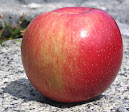
Today we have a large oblate apple, its yellow ribs blending gently with the spring-green valleys between.

|
It wears a swath of coppery russet like a bicorn hat radiating from the well where sits a short stubby stem.
There are crackles of russet on one side, some darker green streaks, and dark grey lenticel dots across the field. There's a smattering of harmless flyspeck (which has nothing to do with flies) as well.
The sunward side has a faint peachy glow on the raised part of the ribs.
Visually: Busy! Interesting.
Tasting Tioga
The flesh is a juicy medium-grained light yellow and the finish is pleasantly astringent. Tioga's crunch is satisfying but not dramatic.
Whence Tioga?
The USDA National Germ Plasm database says that Tioga is a Sutton x Northern Spy cross. (Could the former be Sutton Beauty?) It was created in 1899 by the nation's oldest fruit-breeding program, at Cornell University in Geneva, New York.
The Cornell program was created by an act of the state legislature in 1880. Tioga, which was not released until 1915, was one of its earliest efforts.
The USDA operates a physical germ plasm repository in Geneva that is a source of budwood, but only for professionals and scientists.
The official name of Cornell's breeding program has changed over the years. Earlier references to it on this blog may be to some variation of "the New York State Agricultural Program's breeding program."
Its current name is "Cornell Agri-Tech." Every age gets the branding it deserves.
Speaking of branding: Many of Cornell's early efforts (Cortland, Lodi, Tioga) were named for upstate towns in the Empire State. Today of course, well, every age gets the branding it deserves.
I am grateful to David Doud for providing these from his Countyline Orchard in Indiana.
Link
Town of Tioga, New York.
Comments
Post a Comment
Join the conversation! We'd love to know what you think.