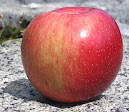
There are so many colors on this apple that I need two of them to show the full spectrum.

|
Regions with a green tint overlap with gold and brown in various combinations: mustard, yellow, olive, brown, orange.
 The Royal Russet, also calle the Brown Russet, is an October apple that
boasts real fall colors decorated by distinct light lenticel dots, some
filled.
The Royal Russet, also calle the Brown Russet, is an October apple that
boasts real fall colors decorated by distinct light lenticel dots, some
filled.
These two are medium to large and moderately ribbed, flattened at top and bottom. The stems are thin.
Doing it Brown
For flavors, a fleeting nutty umami note, similar to an Ashmead's Kernel's, and bits of tangerine. There's just a dash of brown sugar in the mix.
The high sugar level reminded me of the Egremont Russet, though Brown's flavors are more intense.
I think that this apple's lively sweet qualities, and its excellent crunch, would win favor with many, if only more people had the opportunity to try it. (Egremont, of course, is sold next to Braeburn in London supermarkets.)
I consider it a very fine russet. All that sugar must have made it prized for cider in its day.
Brown or Royal?
Meanwhile, the National Fruit Collection of the United Kingdom calls Royal Russet the preferred name for brown, but does not have the apple in its collection.
That absence seems odd for an English apple that (maybe) Shakespeare called "Leathercoat"! (Or not: Leathercoat is a different variety*). So perhaps it originated in North America after all.
Before his death in 2012, Collin Mills cataloged Royal Russet as part of his Hortus Camdenenis project.
It is not unheard of for an apple to have more than one name.
*Leathercoat note:
The NFC listing depicts and describes a very different russet from mine. Yet the colored copperplate of Royal that Mills reproduces resembles my apples closely.
On this basis I reject Leathercoat, embrace Royal, and include Brown.
Russets! My absolute favourite.
ReplyDeleteAfter a quick look at the early sources, I think 'Leathercoat' and 'Royal Russet' are highly likely to have been different varieties, yes.
The earliest mention I could find for 'Leathercoate' is in Parkinson's 'Paradisi in Sole Paradisus Terrestris' in 1629.
Miller lists both 'Royal Russet' and 'Royal Russeting' in various Gardener's Dictionary, Gardeners Kalendar etc. volumes c. 1730s.
There's also a mention of a 'Leathercoat russetin' in Powell's Royal Gardener of 1769.
Both 'Royal Russet' and 'Leather-Coat Russet' are listed in Abercrombie's 'British Fruit Gardener' of 1779, separating the two.
By the time we get to Barron's 'British Apples' in 1884, both 'Leathercoat' and 'Leathercoat Brown Russet' are said to be synonyms of 'Old Leathercoat Russet', and 'Royal Russet' is listed separately, with differing descriptions for each.
Thank you, Darren! This is the kind of detective work I admire.
DeleteThe descriptions of Leathercoat also do not square with the apples that Jesse sent me. So either Royal is not Leathecoat, or I am wrong and Brown is not Royal.