
|
This apple's name mean—oh wait, no it doesn't. (And shouldn't that be des Reinettes?)
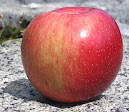
Etymological questions aside, I have two of these, both on the small side of large, round, slightly oblate, with the merest hint of ribbing.
Both have significant russeting on the unblushed peel, which is a muted green-yellow.
The pair blush differently, however. The main photo shows a cheerful red tinged with orange and mottled with russet; russeted lenticels are large. The other's blush is darker and more saturated, and some of the russet on the blush, in the lenticels and elsewhere, is black.
Both are quite firm and smell sweetly of grass and yeast, tokens of the
surface flora. Okay, bite.
Wow. What a wonderfully complex apple. Reine de Reinettes has
medium-grained white flesh and a tender crunch. Its flavors are rich and
intricate against a balanced backdrop enlivened by considerable tart.
There are lush orange and bergamot (my wife says lemon) notes.
Something a bit more tropical--Mango? Melon?--is overwhelmed by the citric
trend.
Perhaps it is the distinct plum flavor I find in the second sample, along with some lemon. There is some very faint vanilla in the finish.
All of these flavors linger on the palate long after the last bite is done. A wonderfully satisfying apple, high flavored after the manner of Ribston and Cox.
 This queen is a classic French variety but seems to have originated in
Holland. Here is a charming
story
(and recipe) about this apple. (And look, it is "des Reinettes,"
seemingly, in French.)
This queen is a classic French variety but seems to have originated in
Holland. Here is a charming
story
(and recipe) about this apple. (And look, it is "des Reinettes,"
seemingly, in French.)
Digression alert: "Reine" of course is French for "Queen," but "reinette" is not "little queen" or "princess" and this fruit is not their sovereign. Some think that reinette means small frog.

|
| Second example |
In the apple sense reinette seems to correspond to "pippin," an apple grown from seed, not grafted. (This is an equally puzzling distinction, however; isn't every variety originally a pippin? My Reinettes were grafts!)
In that sense "King of the Pippins," as this variety is
known in Great Britain,
is a reasonable Anglicization (given the sex change; what does that say
about the cultural differences between England and France?).
One old source, however, gives exactly the opposite meaning.
Beech, in Apples of New York, details the frog theory and also quotes an even older pomologist to the effect that Reinette is a particular French appelation for apples with certain fine qualities, for instance "fine-grained, delicate, crisp, firm flesh."
The "reinette"-named apples I've tried have had many of these great qualities. Little queens, or froglets, all.
YEA! YEA! YEAAA! You have just reviewed the apple that I've been searching for, desperately, for five years -asking at every orchard I've visited, every farmer's market stall. I had two bites of this apple at the Boston Vegetarian Food Festival, fell in love. Asked it's name, hadn't seen it since.
ReplyDeleteThank you, Adam. You are officially my apple-hero.
Now that I've got the name, all I need to do is find the apples, somewhere.
Same experience as you at that festival, and they set me up with a produce bag full as they were closing on Sunday afternoon. I do not understand why anyone grows anything else for anything other than economic reasons or laziness, but there is a tree in a SW suburb of Boston that comes close and achieves it's pinnacle in late November, when much else is past. Perhaps we can put something together, as this tree is very productive and there's only so much my friend and I are inclined to eat or process
DeleteScott Farm, Brattleboro, Vermont. Orchardist Ezekiel Goodband (I kid you not) is wonderfully informative and their stand has an amazing variety of heirloom apple varieties, including Reine de Reinettes and the repulsive looking but delicious Knobbed Russet. Go there. Now.
DeleteScott Farm is a great recommendation, anonymous apple person. In fact, the Reinette in my photo grew at Scott Farm (I bought it at a specialty store in Cambridge.)
DeleteI hope to get up there some day.
Those looking for trees on the West Coast (or to ship) can find them at Trees of Antiquity in Paso Robles CA. I have several trees from this nursery and all have been vigorous, high quality stock.
DeleteThanks for the tip, other anonymous apple lover!
Delete@Library, you're very welcome and have made my day.
ReplyDeletePlease do let us know if you find a local source for these great apples. I'd love to get more next year, they really are marvelous.
If you are looking for this variety, then i am fairly sure you can get it from Ron and Suzanne Joyner at Big Horse Creek Farm in Ashe County NC. E-mail them on Oldapple@bighorsecreekfarm.com these guys are really helpful and have a heap of knowledge. They have this variety in their home orchard
ReplyDeleteDifferent years, different results. Our King of the Pippins was one of the first trees in our orchard to bear fruit, so I have a special fondness for it. That first year, I thought it had a special, pleasing flavor. The next year, in a small taste testing with some friends, it finished last among five apple varieties. Last year I was agreeably surprised with its complex and satisfying flavor. None this year, as we too were hit hard by the early heat and late frost, and only got apples off half a dozen trees.
ReplyDeleteJohn, I guess consistency is another dimension of apple quality. I admit to not taking that into account in my new-fangled rating system.
DeleteScott Farm in Vermont grows these! I tasted them there fall of 2012.
ReplyDeleteAren't they great? Though there does seem to be considerable variation in quality by harvest.
DeleteAnyone know where I might find a Reine de Reinettes (King of the Pippins) tree for my yard?
ReplyDeleteCheers,
Ryan
ryan.sackman@gmail.com
It is interesting that the French seem to specify Calville Blanc d'Hiver OR Reine des Reinettes for their tartes, and yet you give them very different reviews. You seem to dismiss Calville as better suited for cooking, whereas you are raving about Reine des Reinettes as a dessert apple. In reading your review about the Calville Blanc, however, I can't quite figure out what makes it better as a cooker than an eater. I am not picking nits here, but am wondering which of these apples to experiment with here in Southern California. (Neither of them has been shown to do well here by Kevin Hauser, SoCal apple expert, but neither seems to have been tested by him, either.)
ReplyDeleteI do try to acknowledge the culinary qualities of apples such as Calville Blanche, but for the most part based on reputation not experience.
DeleteOn the other hand, my rating of Calville's eating qualities is based on eating them.
By the way I don't "dismiss" cooking apples, it's just that I only evaluate them, in any sort of systematic way, for eating. (I have baked with Calville and found it excellent, but I can't critically appraise it versus other apples because I do not bake much.)
Good luck with the SoCal thing. Kevin H might have some ideas for you, have you asked him?
Yes, I actually have 7 benchgrafts from Hauser growing in my yard--now I am just trying to figure out which other apples to graft to those seven once their big enough! I have King David, Belle de Boskoop, Sierra Beauty, Wickson, Arkansas Black and Lady Williams, and Kerr Crab.
DeleteI think that "Reine de [not "des"] Reinettes makes perfectly good sense. We say "King of kings", not "King of the kings", don't we?
ReplyDeleteVous avez le droit, I guess; I'm just not able to know what is right in French based on English usage.
DeleteActually both are correct.
DeleteScott Farm in Dummerston VT (right near Brattleboro) is a good source of Reine de Reinettes. A few years ago, local Whole Foods stores carried 4 of Scott Farm's heirloom apples (I think through another distributor), but the apples were poorly labeled--some mixed up--and no additional information or samples to tell people what the apples were like. After getting one store's produce assistants to swap labels around I got him to cut open and taste one Reine de Reinettes. He couldn't believe the intense flavor. Sadly, Whole Foods didn't sell many (no consumer education) and seems to have stopped carrying them.
ReplyDeleteThe Scott Farm is an incredible resource for heirloom apple varieties. Zeke Goodband (no, really, his name is Ezekiel Goodband!) apparently wanders through abandoned orchards and brings back cuttings of strange-but-true apples. This year I found, for the first time, a REALLY strange looking but delicious apple called the Knobbed Russet. It looks like one of those apples you'd skip because it's obviously been infected by Ebola, SARS, AIDS, Swine Flu, shingles, and the Gleet. (It's UGLY.) But it is amazingly delicious. Go to Brattleboro soon; you won't regret it.
DeleteNorthwest Cider Supply has RdR whips (teeny-tiny trees with no branches) for sale if you're willing to wait a few years for fruit.
ReplyDeleteReine means Queen not King
ReplyDeleteHi @anonymous: I assume you are responding to the fact that some authorities identify this variety with the English "King of the Pippins."
DeleteIf you reread that part of my post, perhaps you will notice where I note the irony of, or perhaps cultural explanation for, that.
Hi Steve! I am not saying you are wrong, but those photos do not entirely convince me. In the only related Hayes video I can find, Hayes does not taste the fruit, which would have been more dispositive.
ReplyDelete(And, Hayes's apples look very much to me like Reine de Reinette.)
Apple can grow differently in different locales, and I confess to a bias in my photography towards prettier and more-blushed samples.
Note that the National Fruit Collection (UK) positively identifees RdR, KoP, and Parmain d'Or as the same apple.
You have raised an interesting question and I do not consider the matter closed. Far from it! But do you have any other sources you can share?
PS So, are you Romanian? Is it true you have <a href="https://notulaebiologicae.ro/index.php/nsb/article/viewFile/4681/8248:>an apple named Sauron</a>?
https://www.albemarleciderworks.com/orchard/apple/golden-pearmain
ReplyDelete@Anony: I would admire to try that apple some day, but it is clearly not the Reine de Reinettes.
DeleteMy favourite Swedish "appleauthor" Görel Kristina Näslund stated that: Renett may come from the French reinette, which in turn may be derived from reine, the French word for queen. But that explanation is rejected by the pomologist Carl G. Dahl who claimed that the origin is in the Latin rana (frog), in the diminutive form ranetta (little frog), and refers to similarities between the frog's skin and the appkes. What characterizes the rennets? What has made them so popular with connoisseurs? My answer is that we love them for their delicious, firm, aromatic flesh and long shelf life (which can extend into spring-winter). The shell is usually thick and rough. People who have a hard time with the oily surface of certain apple varieties -- eg Signe Tillisch -- like the dry skin of the renetts. In the first edition of his Pomology from 1929, Carl G Dahl lists five subdivisions:
ReplyDelete1. Rambourrenets -- medium or large fruits, eg Canada rennet
2. Solid colored rennets or wax rennets -- small to medium sized, eg Pineapple rennet
3. Red rennets -- medium-sized, eg Adamsparmän, Jonathan, Baumann's Renett
4. Gray rennets -- medium or smaller, eg Leather rennet and Belle de Boskoop
5. Golden rennet -- small to medium sized fruits, eg Cox Orange, Golden renett, Golden parmän, Kasselrenett, Ribston, Blenheim, Harbert's Renett, Queen Louise.
See, also, my discussion of "Reinette."
Delete