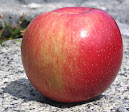
These large apples, oblate and wide, wear a striped red blush over the usual green-inflected yellow. On some examples the green is more pronounced than on others.

|
The blush includes saturated streaks, and lenticels that are more tactile than visual: tiny raised bumps.
Bite
There is also, faintly, a more basso flavor, if it's permitted to mix metaphors with music. My brain keeps jumping to coffee or chocolate though it is neither. Blackberries? Figs? It is not prominent.
The net result is a pleasing mix. These apples were in transit to me for something like a week but are still quite good, though I wonder if they might have a more vigorous crunch fresh off the tree.
Origins
Pomiferous says the apple was introduced in 1922 by the breeding program at the Iowa State Agriculture Experiment Station in Ames.
Orange Pippin calls it "generally similar to McIntosh, but sweeter and firmer." Mine are not firmer, but also were in transit to me for a week.
This is almost certainly one of the many listings that the Yorkshire-based Orange Pippin inherited from All About Apples when that website ceased publication in 2011.
The director of the Iowa breeding program at that time it produced Sharon was none other than S. A. Beach, the creator of the Cortland apple and principal author of the Apples of New York.
Though developed in Iowa, my samples grew in North Dakota. Thanks to Michael Wunsch for these.
Cited
Lantz, Harvey Lee. 1924. "Apples," part 1 of Varieties of Tree Fruits for Iowa Plantings (5–26). Agriculture Experiment Section, Iowa State College of Agriculture and Mechanic Arts, Ames, Iowa.
This is Michael - It is worth noting that this sample was harvested after a couple light to moderate frosts. The flavor of this variety improves dramatically after a frost; we find it be a genuinely good eating apple after a frost, and somewhat bland prior to a frost. The apple has a tendency to drop when it is ripe, but it ripens over a multi-week period, so invariably we tend to get at least a portion of the harvest after frost. It has good texture when freshly picked, and I'm sure that the not-so-good crunch in your samples was due to time the apples spent in transit. This is not the type of apple that would maintain a good crunch sitting out of refrigeration for a week.
ReplyDeleteHi Michael, I was hoping you would tell us more about some of the apples you have shared with us! Readers may be understandably confused about exactly when the apples I review were picked, or for that matter when I tested them, as there can be a gap between those things and publication. Eating is easy, documenting takes time!
Delete