
|
A modern fruit breeder would never name an apple anything like "Anton Poulter."
It would be trademarked as "HoneyCluck" or "Sweet Chicks" etcetera.
But today's apple dates from a gentler time, when a farmer might discover a new apple growing on his* farm (*for surely Anton was a man) and bring it to the state fair or horticultural society.
He'd share or sell budwood, be eponymously immortalized, and return to his farm. That's how things used to be.
Two views

|
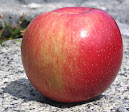
Anton's peal is glossy and smooth, and one must peer closely to discover many small lenticel dots of almost the same color.
Any bruises are small and a consequence of 35 miles in my handlebar bag. These apples were unplanned, but now I get to try them.
Two tries
Flavor beyond that is hard to pin down, but there is spice and a flash of berries. Banana? No, but something a bit round in the background too.
Anton 2 is crisper though still yielding and and granular, and the flesh is juicier and has a green caste. More acidity, and less distinct flavors. The peel stands out with a taste of fresh peas.
I think these two samples bracket two phases of ripeness, and neither is good for eating out of hand. No Sweet Chicks, then!
Anton somewhat resembles Yellow Transparent and Lodi. Like them, it would probably make a mean applesauce.
If I ever get around to breeding my own apples, and one of them turns out to be way too sweet (for my taste--I doubt there is a limit in the current commercial market), I will definitely name it HoneyCluck.
ReplyDeleteI guess the "Sweet Chicks" joke depends on knowing the Wild Twist backstory.
Delete