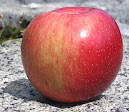
Apple cultivars are, literally, identical clones. Yet they can look very different depending on ripeness, growing conditions, and so forth.
On that score, I have never before seen Ashmeads Kernels like these.

|
Yet there they were, in a basket in a supermarket in Seattle on Halloween.
Complete with PLU stickers.

|
| Not actually a universal Ashmead's number. "4194" is "apple, retailer assigned." ("9" signifies "organic.") |
"Supermarket Ashmead's" was not on my apple bingo card this fall. Surely, though, they must taste the same everywhere.
Right?
Side by side

|
| Nature or nurture? Seattle Ashmead (left) and its New England self. |
The Seattle apples are larger and more elongated than the ones I am used to.
The visual differences are so great that I would not have pegged these as the same variety without the helpful PLU (and signage).
Eating Seattle
I am not finding the nutty or savory note that sometimes, elusively, haunts Ashmead.
The texture betrays time in transit, and these are almost too sweet (hey, press some cider out of these!). Still, the grocery Ashmeads are still a great snack.
Consider this story an illustration of ways that local conditions can determine how an apple looks. I cannot even guess, though, which condition led to which difference.
And now I know what Ashmead's looks like beneath that suede jacket.
I think it's a mislabelling! As it's organic produce that rules out the effects of certain sprays that can change the look. It's too tall for AK, only the stalk is right. Be interesting if it's a sport though as it's much more "supermarket friendly" than the AK we all know and love.
ReplyDeleteI suppose I am too trusting of the claims of sellers (and growers: have been fooled there too). Your observation about organic is not something I'd considered.
DeleteBut should we completely rule Ashmed's out? The flavor is less complex but still lemony in the way that Ashmead's is.
At least one other knowledgeable commenter agree with you that Ashmead's is impossible.
I wonder if it is not location but more likely mislabeled trees? That is quite a difference in appearance and taste. Look just at the varieties released by the USDA that wound up not being correct with Foxwhelp, or Fauxwhelp as it is called now, being one. It has been found to be Le Bret. Same thing with Tremlett's Bitter which is now being called Geneva Tremlett's.
ReplyDeleteThere is a huge commercial orchard with a store near us and every year they put out huge bins of an apple they say is Grimes Golden. Those apples are bright green with white tart flesh. I have told them that what they are selling as Grimes Golden is not that variety, even the name should tell them that. We live on the other side of the valley and our Grimes Golden apples are dark yellow with yellow flesh and a spicy taste.
You are not the only one who thinks so, see the comment from OrchardyThing above! As you point out, errors are possible at all levels; one would not expect the US FDA to screw up, but it has.
DeleteThese indeed look suspicious, but I will say that Washington State is famous for elongated apples such as the iconic Red Delicious shape that adorns the Washington apple logo. I remember having heard or read that this is due to the cool nights that pervade the Washington apple-growing regions. My Liberty apples this year (grown in a particularly non-warm-night part of the state) were on the elongated side of the range of Liberty shapes I see in pictures. My Ashmead tree did not have any apples on it this year--only it's second year of life since being planted here, and no profusion of apple blossoms from other trees to ensure pollination. (I am going to graft a branch of Wickson on the tree this spring to aid pollination of this triploid variety.)
ReplyDeleteWestern WI: I, too, am suspicious. But, assuming you kept the core, why don’t you send a sample in to Washington State for a DNA analysis? I’ve run into this problem when exploring the Seed Savers or hard in Decator IA — and that’s their solution.
ReplyDeleteI’ve also seen a fair amount of variation in Gold Rush. It seems to be getting larger and sweeter over the years. But the flavor profile remains the same. . .
I wonder how much would it cost to perform such a test...
Delete@Sparcher, recently I reported on the WSU lab that was charging $120 per test. The lab requires a sample of the leaf, not the fruit.
DeleteInteresting, too, that the apple grown in New England closely resembles the apples grown where I am in England despite a very different climate. I’d expect if anything that the Seattle apple would be more similar to the English given the similarities of climate (mild, damp etc) - unless of course it was grown in eastern Washington.
ReplyDeleteI'm going to add a vote to the mis-labelling column. That doesn't look like any of the Ashmead's Kernel apples that we grow at work (North Cheshire, UK), even allowing for the usual size variation on a tree.
ReplyDeleteIt's easily done. I have a tree on my allotment that I bought as 'Cornish Aromatic' that turned out to be non-typical and I'm fairly confident is actually 'Devonshire Quarrenden'. Label came off the next tree over? Grabbed the wrong scion at grafting? So many ways.
I also favor the mislabeling explanation. I agree the stem looks like Ashmead's, but that's all.
ReplyDeleteIn addition to what others have said I'll add: I don't believe that PLU stickers are put on at the all orchards. Sometimes those are added at the apple storage facility, or possibly at the wholesaler. That provides other opportunities for mislabeling.
But I was impressed that a PLU sticker even exists for Ashmead's Kernel, so I decided to check it's the right PLU number. Try this website: plufinder.com. Instructions say to enter a 4 or 5 digit PLU (so 94194 is a possible PLU), but when I typed that in, it said it didn't exist. This makes me wonder if it's a local number. Try entering "apple". But fyi, Cripps Pink #3919, Macoun #3073, Baldwin #3075. Not an easy tool to use.
I did try entering 9419 and 4194 as well, but no Ashmead's Kernel
Curiouser and curriouser.
It's a code for "retailer assigned." (Check out the caption for the photo.) Still, someone printed these up for Ashmead, even if they stuck them on the wrong apple!
DeleteSorry, missed the photo caption. But yes, someone made the PLU stickers and put them on.
DeleteNew comment: only $1.98/pound for organic Ashmead's Kernel? That's a very good price.
I certainly took note of that! It supports the argument (in other comments) that these are not Ashmead.
DeleteOn the other hand, the Pacific Northwest is a whole different world, especially agriculturally.
PLU numbers are a bit of a conundrum. In order to apply/get one for a variety, three retailers (Kroger/Trader's/HEB/etc) have to attest the variety is 'in the trade'. But to break 'in the trade' the variety must have a PLU number. The (9)4194 is used at the store level, but it's clunky at best. I do think the above examples are not Ashmeads Kernel, climate plays a role, but Ashmeads has been widely grown across the US and this level of non-comformity has not been noted. D Doud
ReplyDeleteDavid speaks as one who knows, of PLU rules and apples alike.
DeleteRubinette maybe?
ReplyDeleteGala on steroids :-D
Delete+1 vote for mislabeling: it happens...
ReplyDeleteP.S.
For suspicious apples, I would strongly suggest taking some photos of the seeds:
it helps a lot in identifying the actual cultivar.